ASR Pipeline at EFICAD
Context. EFICAD is a 30-person software publisher behind the SWOOD suite (SWOOD Design, SWOOD CAM, SWOOD CAM Nesting, SWOOD BW), a set of SolidWorks add-ins used by furniture and shopfitting manufacturers to drive parametric design all the way to CNC machine programs. I worked there from February 2022 to September 2025 as technical architect and technical writer, and built the company's online training platform.
Problem. In my final year, reseller training sessions were recorded as single 2 to 3 hour videos. Turning one into e-learning material required an accurate transcript, subtitles, and a split into 5 to 10 minute modules following a teaching progression. Two things made this expensive. The SWOOD suite uses invented domain vocabulary that every ASR engine transcribes incorrectly, and the recordings contain attendee questions and off-topic interruptions that do not belong in a finished module. The entire process was manual.
Constraints. English audio, acceptable quality, video at 16 fps. Output quality could not be traded for speed: the manual process produced error-free transcripts, so the pipeline had to match that, not approximate it. Three people needed to review and validate the intermediate output, which ruled out any single-machine workflow.
Approach. Three chained tools with a human checkpoint between each. The first downloads the source video from an unlisted URL, transcribes it with Whisper Large, then corrects domain vocabulary using a JSON dictionary. Each term carries context words that confirm a substitution and context words that block it: SWOOD is corrected next to SWOOD CAM or SWOOD Design, and left alone in "wood texture". Each entry also holds a definition field, unused for now, designed for a later version where an LLM arbitrates ambiguous cases. The second tool sends the corrected transcript to an LLM holding the full product training documentation in context, which segments the session into named chapters and drops unwanted interventions. Its output is the YouTube description text that drives automatic chaptering. The third tool takes the chaptered video back and splits both the video and the subtitle track, re-timed against the new module boundaries.
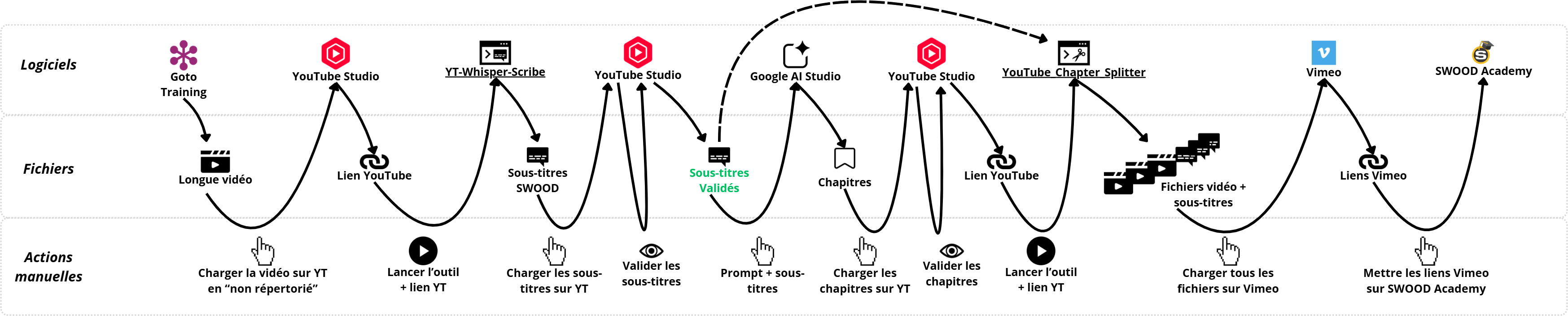
Result. Before building anything, I measured the manual workflow on my own time, normalised per hour of source video. Raw Whisper output sits around 10% WER on this material, almost entirely on domain vocabulary. The dictionary pass brings it close to zero, which turns the remaining human step from correction into proofreading. Final transcripts are still error-free, and the pipeline reaches that same output five times faster. Build time, including the domain dictionary, was about six weeks. Before leaving, I wrote a private course on the training platform so colleagues could run and maintain the pipeline, dictionary updates included. As of early 2026 the pipeline is still in use at EFICAD.
Limits. The dictionary was evaluated on the recordings used to build it, so its measured accuracy is optimistic: a known term can still be missed in a new video whose surrounding context is not yet covered. In practice the dictionary is meant to be extended as new sessions are processed, which is why maintenance was part of the handover. Both code tools run from the command line, which discouraged colleagues unused to a terminal, and a minimal interface would probably have driven wider adoption. Finally, the pipeline depends on YouTube for storage and retrieval: a policy change breaks it. That dependency was a deliberate trade for free storage and a shared review surface across three people.